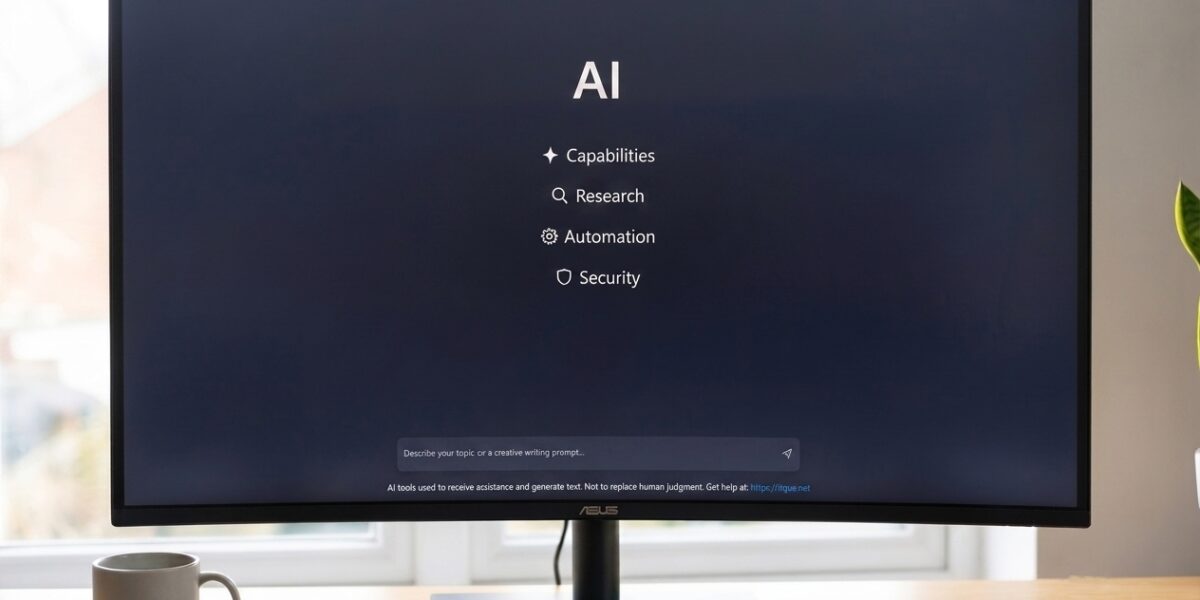

Artificial intelligence is no longer the future. It is firmly part of the present. That means that AI transformation isn’t a problem of technology. AI transformation is a problem of governance.
In the rush to adopt AI tools, organizations cannot overlook the importance of creating an AI policy for business that establishes a set of rules, technical controls, and oversight processes to ensure these technologies are used safely.
This is what we call AI governance.
The genie isn’t going back in the bottle. Employees are already using AI tools, and how they use these technologies can create serious compliance and security risks if not carefully controlled. Without these control mechanisms in place, shadow AI—the unauthorized use of AI tools— becomes a major security vulnerability.
What is AI Governance?
No matter what industry you operate in, you’d be hard pressed to find a business that isn’t exploring what AI tools can do, at the very least. Many businesses have already adopted these tools.
But in this modern AI arms race, businesses need a system in place to control how AI tools will be used within their organization. AI tools can provide major benefits, but they are not without risk. Managing that risk is the basis of governance strategies.
To be clear, AI governance isn’t about banning AI. It’s about establishing a framework that lets businesses adopt AI technologies in a secure, controlled manner.
AI tools can dramatically improve a business’s capabilities, but they also introduce the potential for increased security and compliance risks. Without AI usage standards, there is no oversight of how AI is used. There are no policies, no employee training, and no visibility into data sharing. These policies help businesses create accountability for how these tools are used across an organization.
Without that oversight, shadow AI becomes a real risk for an organization.
What is Shadow AI?
If you’ve been around the IT game for any length of time, you might have heard the term “shadow IT”. It refers to the usage of unauthorized devices, software, or applications that are outside the oversight of company IT. Like using a personal smartphone for business-related tasks.
Shadow AI is a similar concept, except this involves employees using unauthorized AI tools without approval or oversight from their employer.
An example of shadow AI could be an account executive who pastes a customer contract into ChatGPT, or a developer who uploads code they’re working on into an AI coding assistant, without leadership’s knowledge.
Why does that matter?
The data that users input into some AI systems can potentially be used to train the AI models, or be retained by third-parties. This can become a major security issue.
Companies that lack policies to control how AI tools are used can quickly expose themselves to the risks of shadow AI.
The Real Risks of Shadow AI
AI tools are supposed to make life easier. Employees often turn to them to help them automate repetitive tasks, summarize meetings, or write or create code faster. But without governance policies in place, shadow AI can create real problems for an organization.
Data Leakage
Publicly available AI models rely on massive amounts of data to improve their capabilities. That data often comes from the prompts that users input.
So when an employee pastes confidential information like customer records, financial data, source code, or legal documents into a public AI model, they can unintentionally be exposing that data to unauthorized third-party access.
Some AI models can retain submitted data for training, logging, or improvement purposes, which can create real contractual and regulatory violations.
Compliance and Regulatory Risk
Businesses that handle consumer data have a responsibility to keep that data safe. Sharing that data with public AI platforms can potentially violate CCPA, GDPR, or other data privacy and protection laws.
Even when AI vendors claim that data submitted is isolated and not shared, sharing it in the first place can still be a violation of data privacy laws. That exposes businesses to statutory fines and penalties, as well as reputational damage.
Security Risks
AI tools often integrate with email systems and cloud drives, giving them access to proprietary information and internal documents. Sometimes they also request excessive permissions. Uncontrolled, malicious or poorly secured AI apps can become an attack surface for cyberattacks.
AI Hallucinations
We tend to think of AI as being absolute, but in reality AI can make mistakes. These are often referred to as hallucinations. They can range from incorrect or even completely fabricated information to flawed code or plagiarized text or images. As a result, AI outputs cannot be trusted to be 100% accurate. Without an oversight framework in place, employees who use AI regularly are more likely to use AI outputs without verifying them.
That creates real risk for a company. Simply taking AI outputs at face value can create serious legal and reputational risk.
Lack of Visibility
To keep a business secure, IT teams require visibility into the tools that employees are using. When IT doesn’t know what AI tools employees are using or what data is being shared, it creates a huge blind spot for security.
Managed IT providers like ITque help clients combat the risks of shadow AI through processes like network monitoring, endpoint management, and other security tools that help identify and control unauthorized AI usage.
Why AI Transformation is a Problem of Governance
Right now, most businesses are still exploring the potential of AI at a company level. Whether they know it or not, a shadow AI ecosystem likely already exists within most organizations.
That means it’s not a matter of “if AI tools will be used”. The tools are there, and they’re easy to access, with or without the knowledge of leadership or IT.
The bigger question is how will your business put a system of policies, oversight, and security controls in place to ensure AI tools are used responsibly.
The companies that succeed with AI will be the ones that balance innovation with governance. Establishing clear AI governance documentation helps their employees use AI tools responsibly, and avoid shadow AI risk.
Managed IT and cybersecurity providers help companies manage the risk of these technologies by implementing structured AI policies, creating oversight, and deploying security controls. Managed providers can often help train employees so they understand how to use AI tools responsibly and at scale.
Practical Steps for Building an AI Governance Framework
If you’ve been working with AI tools without proper internal AI controls in place, there are steps you can take to get control over shadow AI and create oversight and accountability.
1. Identify Shadow AI Usage
The first step is to identify where shadow AI already exists.
A good place to start is by conducting surveys to see what tools employees are already using. AI monitoring platforms can also help with network and endpoint monitoring to get a more accurate picture of what tools are being used on company networks. Browser and app audits also help.
2. Create an AI Policy for Businesses
When there are no clear AI policies in place, it’s hard to expect employees to know what is acceptable and what is not. AI policies for businesses should clearly separate approved tools from restricted ones, as well as establish restricted data categories.
3. Train Employees
Employees need to become educated about AI usage, not scared of it. They need clear guidelines for what constitutes acceptable use, as well as what they can share and not share with AI tools.
Another key aspect of governance policies is teaching employees what their compliance responsibilities are. They should also understand that AI outputs are not 100% reliable. Learning how to verify AI outputs is a must for every employee.
4. Implement Technical Controls
Technical controls are where responsible AI practices go from just a nice idea to something that can actually be implemented. Tools are available that can limit or block access to unauthorized AI platforms on company devices. Data loss prevention (DLP) tools can inspect and block data from being transmitted to external AI models, and endpoint controls can be used to secure individual devices like company phones and tablets. Technical controls are where responsible AI practices go from just a nice idea to something that can actually be implemented. Tools are available that can limit or block access to unauthorized AI platforms on company devices. Data loss prevention (DLP) tools can inspect and block data from being transmitted to external AI models, and endpoint controls can be used to secure individual devices like company phones and tablets.
5. Continuously Update AI Governance Policies
AI moves fast. New tools are constantly emerging, and regulations struggle to keep up with them. That means business owners need to continuously review and update their governance policies to stay on top of emerging threats. Managed IT providers can help you do exactly that.
How Managed IT Providers Help Reduce Shadow AI Risk
If keeping up with the constantly changing world of AI feels overwhelming, you’re not alone.
Many businesses are experiencing this exact situation now, but it’s the small and mid-sized businesses that lack an internal IT team who face the greatest risk from shadow AI.
As managed IT service providers, ITque helps our clients root out shadow AI and put in place responsible AI practices.
That starts by monitoring where AI is currently being used in an organization. Our IT teams can use network monitoring and endpoint management to identify where unauthorized AI applications are being used and their potential data exposures.
We help support the creation of AI governance documentation that outlines approved AI tools, acceptable use guidelines, and safe data handling practices. Our team can also help train employees on the risks of shadow AI and safe data handling for AI systems, as well as help your organization stay on top of evolving AI trends.
Need Help Developing an AI Policy for Your Business? Contact ITque
AI adoption is increasing, and so is the risk of uncontrolled AI usage.
AI governance is not about banning the use of AI. It’s about putting in place controls and restrictions that promote safe use of these tools.
Businesses have the potential to benefit greatly from AI tools, but they need to be used in a safe and responsible way that protects the organization from the potential risks. Governance policies are how to do that.
If you’re struggling with how to implement AI tools in your organization, or rein in shadow AI, ITque can help.
Our managed IT services can help you put a framework in place that gives your organization control over how AI tools are used, and minimizes the risk of data exposure.
Contact ITque today to speak with our team about our managed IT services, and let us help you integrate AI tools into your organization effectively.